
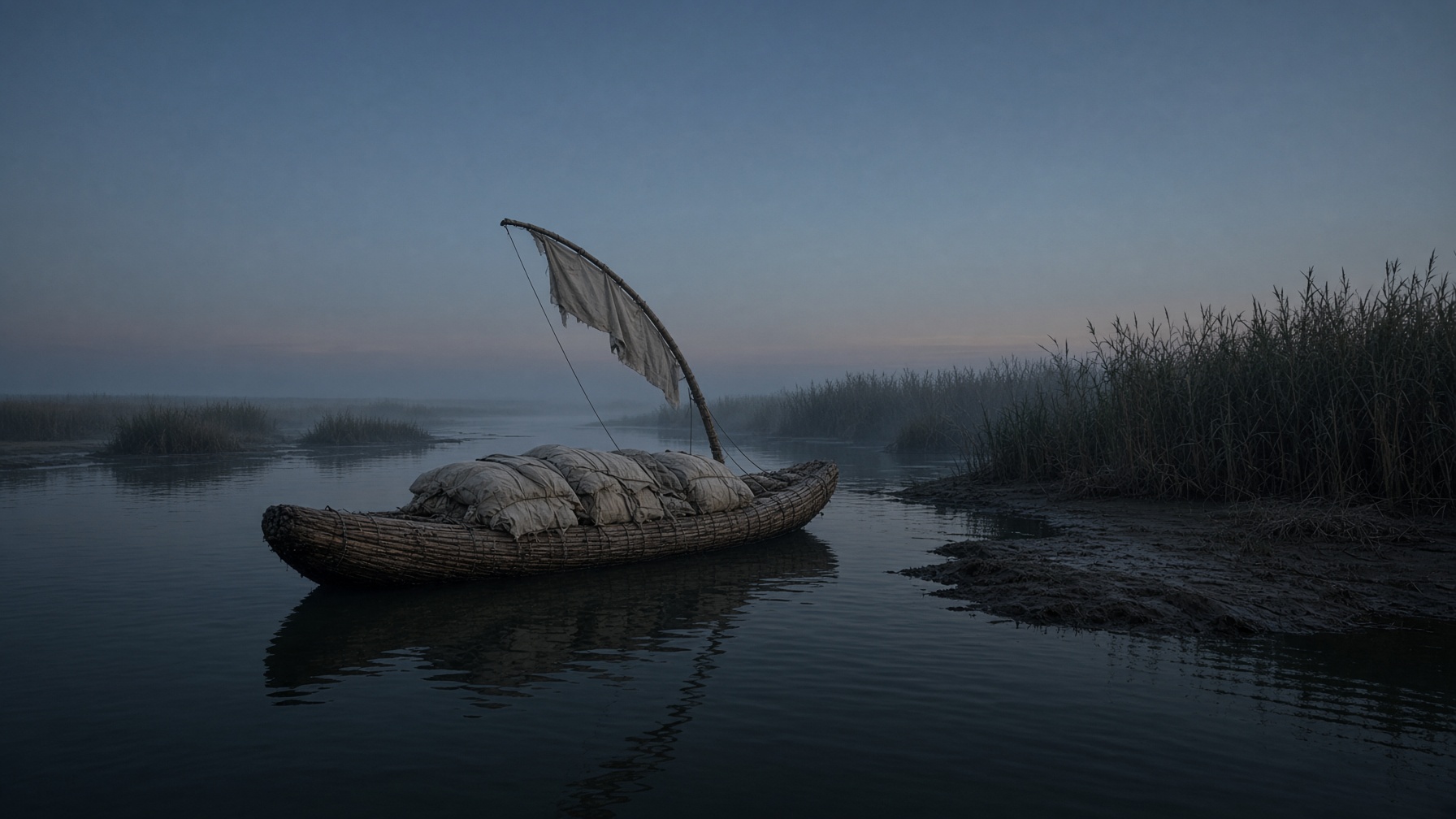
I · Eridu
Literary narrative
A boat leaves the quay carrying more than objects.
Inana has gathered what the poem calls the divine powers. The Boat of Heaven has already left.
Transcript
The Boat What must a world know how to do? A boat leaves the quay carrying more than objects. Inana has gathered what the poem calls the divine powers. The Boat of Heaven has already left. Two cities, a freshwater deep Eridu sits at the southwestern edge of the southern Mesopotamian alluvium, in what is now southern Iraq, near the meeting of sweet water and marsh. The gulf then came farther inland than it does now. Archaeology knows Eridu as one of the oldest urban sites in the region; later Sumerian tradition called it the first city. Enki (Ea in Akkadian) is the god of the abzu, the subterranean freshwater, of cunning, craft and incantation. His house is there. Unug (Uruk) is Inana’s city further upstream on the Euphrates system. Inana (ETCSL writes Inana; many English books write Inanna) is not a later allegory for ‘the feminine.’ In this composition she is a goddess who intends, travels, drinks, takes and refuses to give back. The same goddess is the evening and morning lamp. Akkadian names her Ištar. Omen tablets name the planet Ninsianna. Later English calls that wanderer Venus. This poem does not schedule her. It loads a boat. The road between them is water. The vessel is named: the Boat of Heaven. ma2-an-na. Capacities, in this telling, are things that can be loaded, sworn over, and moved. Two cities, one water Eridu and Unug can be planted. Southern Mesopotamia. Eridu near the marsh. Unug, Uruk, upstream. This is a map, not the Boat of Heaven, and not a reconstruction of the poem’s voyage. A feast, then a transfer The surviving poem (ETCSL 1.3.1) is broken. About six lines are missing at the start; more will vanish later. What remains is enough. Inana directs her steps toward Enki’s abzu. Enki, who knows intentions before they arrive, tells his minister Isimud to receive her as a colleague: butter cake, cool water, beer at the Lions Gate, the holy table of An. They drink. Bronze vessels fill. A competition begins. Then, after a gap of some thirty-five lines, Enki is giving. “In the name of my power, in the name of my abzu, I will give them to holy Inana, my daughter.” He does not give her a tool. He does not give her a kingdom. He gives her, in batches, things English has trouble keeping in one list. Holy Inana received heroism, power, wickedness, righteousness, the plundering of cities, making lamentations, rejoicing. What was on the boat Do not call these magic objects. Do not file them as the gifts of civilization and walk on. Read the list the poem actually gives. Force and its opposite. heroism, and power. wickedness, and righteousness. the plundering of cities. making lamentations, and rejoicing. How a people stand and move. deceit. the rebel lands. kindness. being on the move, and being sedentary. Crafts. the craft of the carpenter. the craft of the coppersmith. the craft of the scribe. the craft of the smith. the craft of the leather-worker. the craft of the fuller. the craft of the builder. the craft of the reed-worker. Care, fire, kin. wisdom. attentiveness. holy purification rites. the shepherd’s hut. piling up glowing charcoals. the sheepfold. respect. awe. reverent silence. the kindling of fire, and the extinguishing of fire. hard work. the assembled family. descendants. Strife and judgment. strife, and triumph. counselling, and comforting. judging, and decision-making. Offices of a world. office of en priest. office of lagal priest. divinity. the great and good crown. the royal throne. the noble sceptre. staff and crook. noble dress. shepherdship. kingship. office of egi-zi priestess. office of nin-diĝir priestess. office of išib priest. office of lu-mah priest. office of gudu priest. constancy. Going down, coming up. going down to the underworld, and coming up from the underworld. kur-ĝara priest. sword and club. saĝ-ursaĝ cultic functionary. Garment, hair, standard. black garment, and colourful garment. a hair-style, uncertain. standard. quiver. Sex, speech, song. sexual intercourse, and kissing. prostitution. forthright speech, and deceitful speech. grandiloquent speech. cultic prostitute. holy tavern. hierodule of heaven. loud musical instruments. the art of song. venerable old age. The surviving list is damaged. About seventy-eight lines are missing after the first transfer, and later recitals do not perfectly reconstruct them. What remains is already broader than a modern word for ‘civilization’ can carry. The quay, the hangover, the chase Inana gathers the powers and embarks. The Boat of Heaven leaves the quay. Only as the beer clears does Enki ask Isimud what has been given. Isimud recites the cargo back to him. Enki sends Isimud to retrieve the boat. Inana’s answer is a legal one: “How could my father have changed what he said to me? Has he sworn falsely by the name of his power and by the name of his abzu?” Isimud seizes the boat with enkum, with fifty giants of Eridu, with fifty lahama of the subterranean waters, with the great fish, with the guardians of Unug, and at the Id-surungal. The composite names six recoveries. A seventh attempt is fragmentary. Each time Inana, with her minister Ninšubur, takes it back. The boat reaches Unug Kulaba at the Gate of Joy. Enki, at the end, acknowledges the transfer. The me are in Uruk. Limits that must stay visible The text. A Sumerian narrative in which Inana obtains a long inventory of me from Enki in Eridu and carries them to Uruk by boat, against his later attempt to reclaim them. The history. Eridu and Uruk are real places. Enki and Inana are gods of a historical religion. The composition as we read it is known from later copies, especially Old Babylonian. It is not a documentary of a historical theft. The goddess and the planet. Inana, Ištar and Ninsianna are names of one goddess whose sky-form is the planet Venus. That identity is ordinary Mesopotamian religion and astronomy. It is not a plot point of this poem. Enki calls her his daughter here. Uruk already exists. Eridu already holds the me. She does not found civilisation. She moves a mixed cargo from a house that had it to a city that could keep it. The me. Sumerian me (Akkadian parṣu, in some contexts) has been rendered divine powers, ordinances, offices, arts, cultural norms, essences of ordered life. No single English word carries the range. The list includes crafts and kingship and also deceit, prostitution, lamentation and going to the underworld. If the word feels too large, that is the finding. What this is not. It is not proof that ‘Sumerians invented civilization.’ It is not a manual of progress from primitive to advanced. Neighbouring peoples without this poem had law, memory, craft and song. The same goddess Morning and evening are one body. Look west after sunset. Look east before dawn. One wanderer, later called Venus. This is not a map of Eridu, and not a sky table. The poem still loads a boat. What this story thinks a world needs Not only fire and grain. A world, in this telling, needs the craft of the reed-worker and the office of the gudu priest. It needs kindness and the plundering of cities. It needs forthright speech and deceitful speech. It needs the kindling of fire and the extinguishing of fire. It needs sexual intercourse, kissing, the holy tavern, the art of song, venerable old age, judging, and going down to the underworld. The inventory refuses the modern split between tool, institution, vice, art and relation. That refusal is the story’s sharpness. The comparison with our later lists is ours, not theirs. What counts as a human capacity? Inana has another story Her descent through seven gates belongs to The Hero’s Journey. The cargo of the me belongs here. One canonical home each. The same goddess is a lamp The sky calendar and the personal Venus clocks live in The Book of 42. This room keeps the boat. One canonical home each.
I
Literary narrative
Sumerian-language composition; southern Mesopotamia
Literary composition; Old Babylonian copies of an older tradition
The object
The Boat of Heaven, loaded
The question
What must a world know how to do?
Bring me there
Two cities, a freshwater deep
Eridu sits at the southwestern edge of the southern Mesopotamian alluvium, in what is now southern Iraq, near the meeting of sweet water and marsh. The gulf then came farther inland than it does now. Archaeology knows Eridu as one of the oldest urban sites in the region; later Sumerian tradition called it the first city. Enki (Ea in Akkadian) is the god of the abzu, the subterranean freshwater, of cunning, craft and incantation. His house is there.
Unug (Uruk) is Inana’s city further upstream on the Euphrates system. Inana (ETCSL writes Inana; many English books write Inanna) is not a later allegory for ‘the feminine.’ In this composition she is a goddess who intends, travels, drinks, takes and refuses to give back. The same goddess is the evening and morning lamp. Akkadian names her Ištar. Omen tablets name the planet Ninsianna. Later English calls that wanderer Venus. This poem does not schedule her. It loads a boat.
The road between them is water. The vessel is named: the Boat of Heaven. ma2-an-na. Capacities, in this telling, are things that can be loaded, sworn over, and moved.
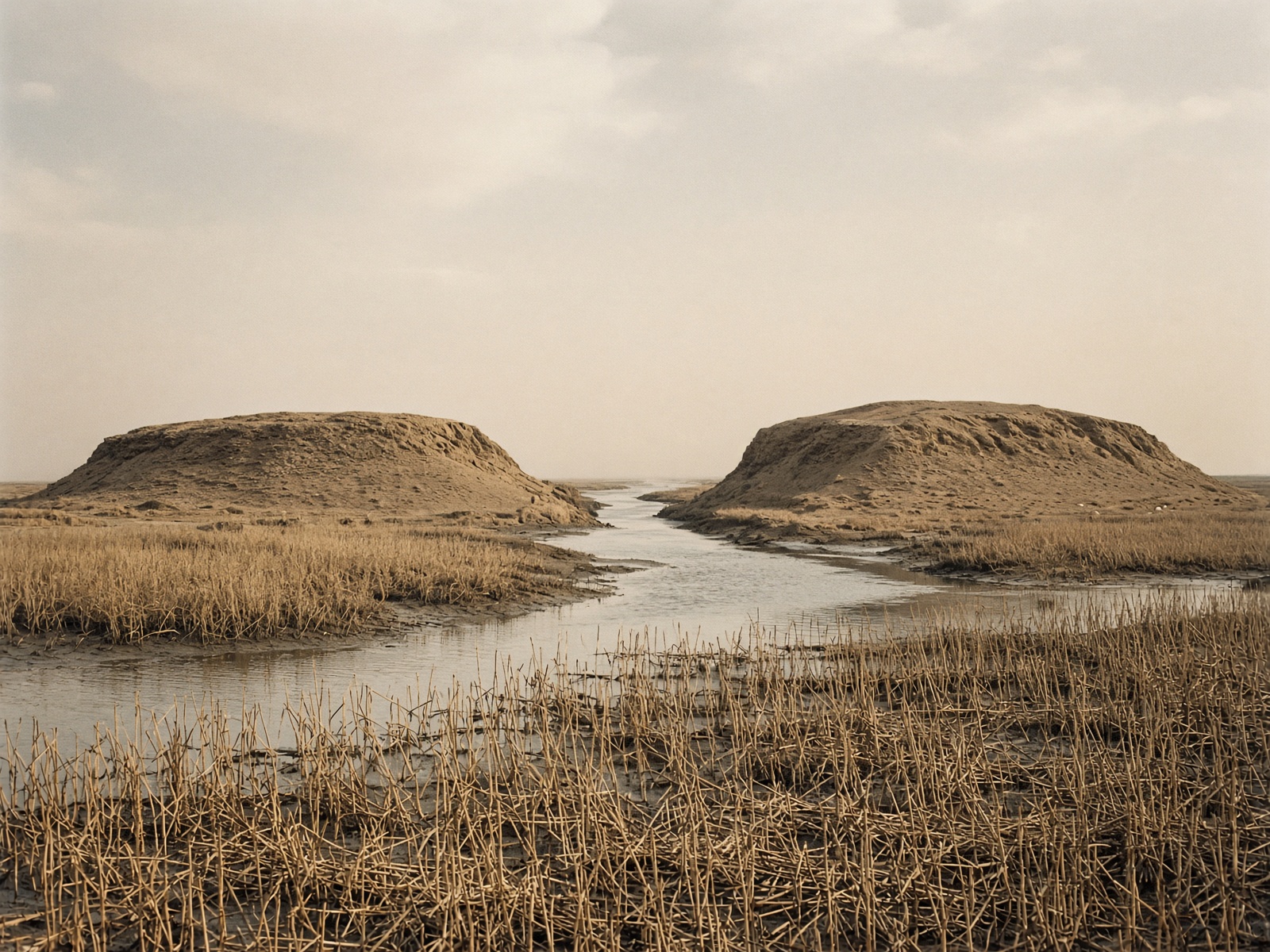
Two cities, one water
Eridu and Unug can be planted.
- EriduEnki’s house · marsh
- UnugUruk · Inana
- gulf
- PlantedA city that can be walked
- WaterThe road, not a surveyed track
MapSouthern Mesopotamia. Eridu near the marsh. Unug, Uruk, upstream. This is a map, not the Boat of Heaven, and not a reconstruction of the poem’s voyage.
Let the story happen
A feast, then a transfer
The surviving poem (ETCSL 1.3.1) is broken. About six lines are missing at the start; more will vanish later. What remains is enough.
Inana directs her steps toward Enki’s abzu. Enki, who knows intentions before they arrive, tells his minister Isimud to receive her as a colleague: butter cake, cool water, beer at the Lions Gate, the holy table of An.
They drink. Bronze vessels fill. A competition begins. Then, after a gap of some thirty-five lines, Enki is giving.
“In the name of my power, in the name of my abzu, I will give them to holy Inana, my daughter.”
He does not give her a tool. He does not give her a kingdom. He gives her, in batches, things English has trouble keeping in one list.
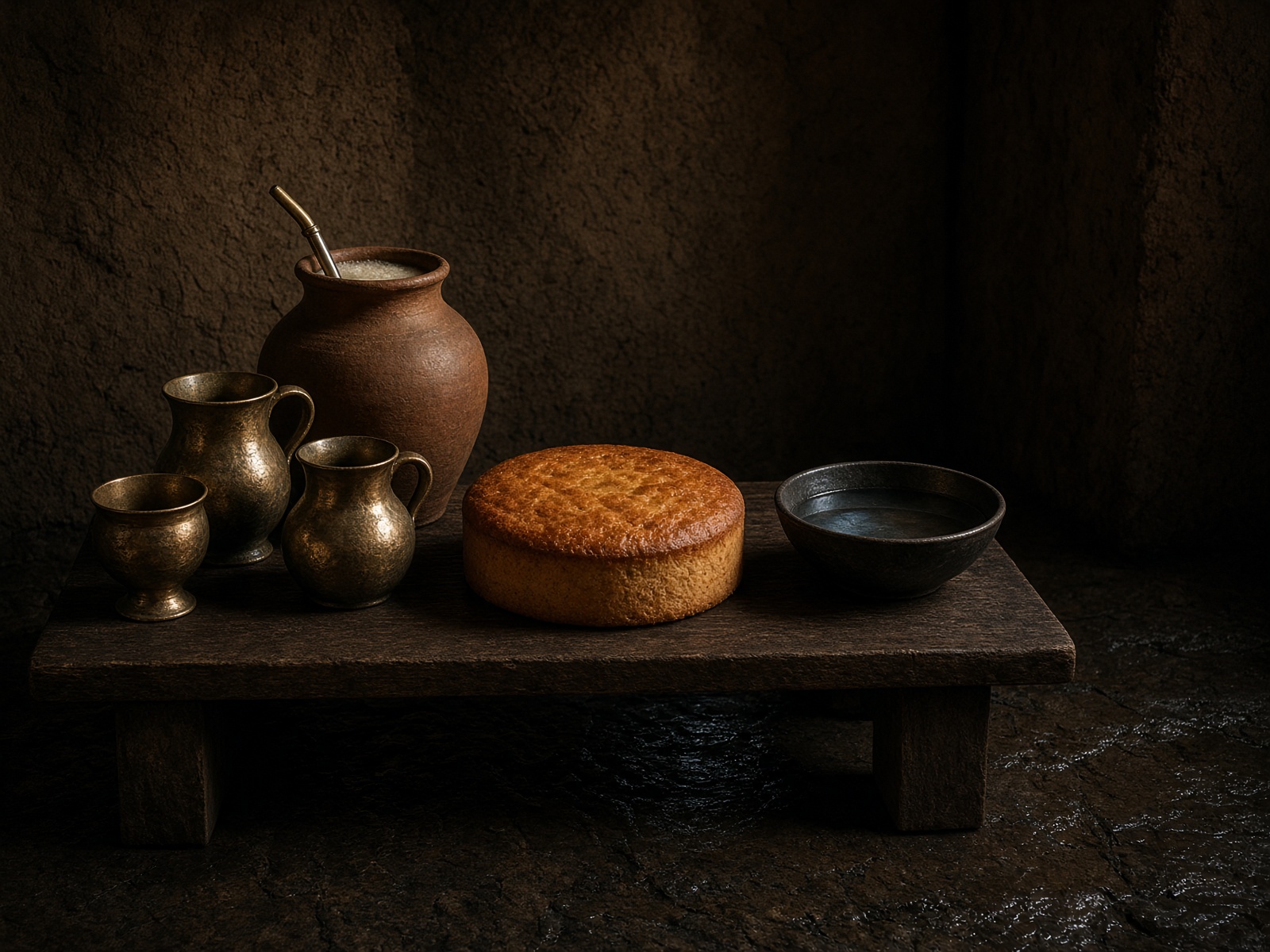
Holy Inana received heroism, power, wickedness, righteousness, the plundering of cities, making lamentations, rejoicing.
The cargo
What was on the boat
Batches follow the poem’s own recitals, not a modern museum taxonomy. Where the poem gives a pair, both sides are cargo. Gaps in the tablets remain gaps.
Force and its opposite
- heroismandpower
- wickednessandrighteousness
- the plundering of cities
- making lamentationsandrejoicing
How a people stand and move
- deceit
- the rebel lands
- kindness
- being on the moveandbeing sedentary
Crafts
- the craft of the carpenter
- the craft of the coppersmith
- the craft of the scribe
- the craft of the smith
- the craft of the leather-worker
- the craft of the fuller
- the craft of the builder
- the craft of the reed-worker
Care, fire, kin
- wisdom
- attentiveness
- holy purification rites
- the shepherd’s hut
- piling up glowing charcoals
- the sheepfold
- respect
- awe
- reverent silence
- the kindling of fireandthe extinguishing of fire
- hard work
- the assembled family
- descendants
Strife and judgment
- strifeandtriumph
- counsellingandcomforting
- judginganddecision-making
Offices of a world
- office of en priest
- office of lagal priest
- divinity
- the great and good crown
- the royal throne
- the noble sceptre
- staff and crook
- noble dress
- shepherdship
- kingship
- office of egi-zi priestess
- office of nin-diĝir priestess
- office of išib priest
- office of lu-mah priest
- office of gudu priest
- constancy
Going down, coming up
- going down to the underworldandcoming up from the underworld
- kur-ĝara priest
- sword and club
- saĝ-ursaĝ cultic functionary
Garment, hair, standard
- black garmentandcolourful garment
- a hair-styleuncertain
- standard
- quiver
Sex, speech, song
- sexual intercourseandkissing
- prostitution
- forthright speechanddeceitful speech
- grandiloquent speech
- cultic prostitute
- holy tavern
- hierodule of heaven
- loud musical instruments
- the art of song
- venerable old age
The surviving list is damaged. About seventy-eight lines are missing after the first transfer, and later recitals do not perfectly reconstruct them. What remains is already broader than a modern word for ‘civilization’ can carry. ETCSL 1.3.1; Farber-Flügge 1973.
Stop at the strange thing
The quay, the hangover, the chase
Inana gathers the powers and embarks. The Boat of Heaven leaves the quay. Only as the beer clears does Enki ask Isimud what has been given. Isimud recites the cargo back to him. Enki sends Isimud to retrieve the boat.
Inana’s answer is a legal one: “How could my father have changed what he said to me? Has he sworn falsely by the name of his power and by the name of his abzu?”
Isimud seizes the boat with enkum, with fifty giants of Eridu, with fifty lahama of the subterranean waters, with the great fish, with the guardians of Unug, and at the Id-surungal. The composite names six recoveries. A seventh attempt is fragmentary. Each time Inana, with her minister Ninšubur, takes it back. The boat reaches Unug Kulaba at the Gate of Joy.
Enki, at the end, acknowledges the transfer. The me are in Uruk.
Show me the source
A composite from broken tablets
There is no one “original tablet” of this story sitting in a museum case as a complete book. The readable English is a scholarly composite assembled from multiple witnesses, with gaps marked. Gertrud Farber-Flügge’s 1973 edition, Der Mythos “Inanna und Enki” unter besonderer Berücksichtigung der Liste der me, remains the specialist study of the me-list. ETCSL is the public English door. It is not the last word.
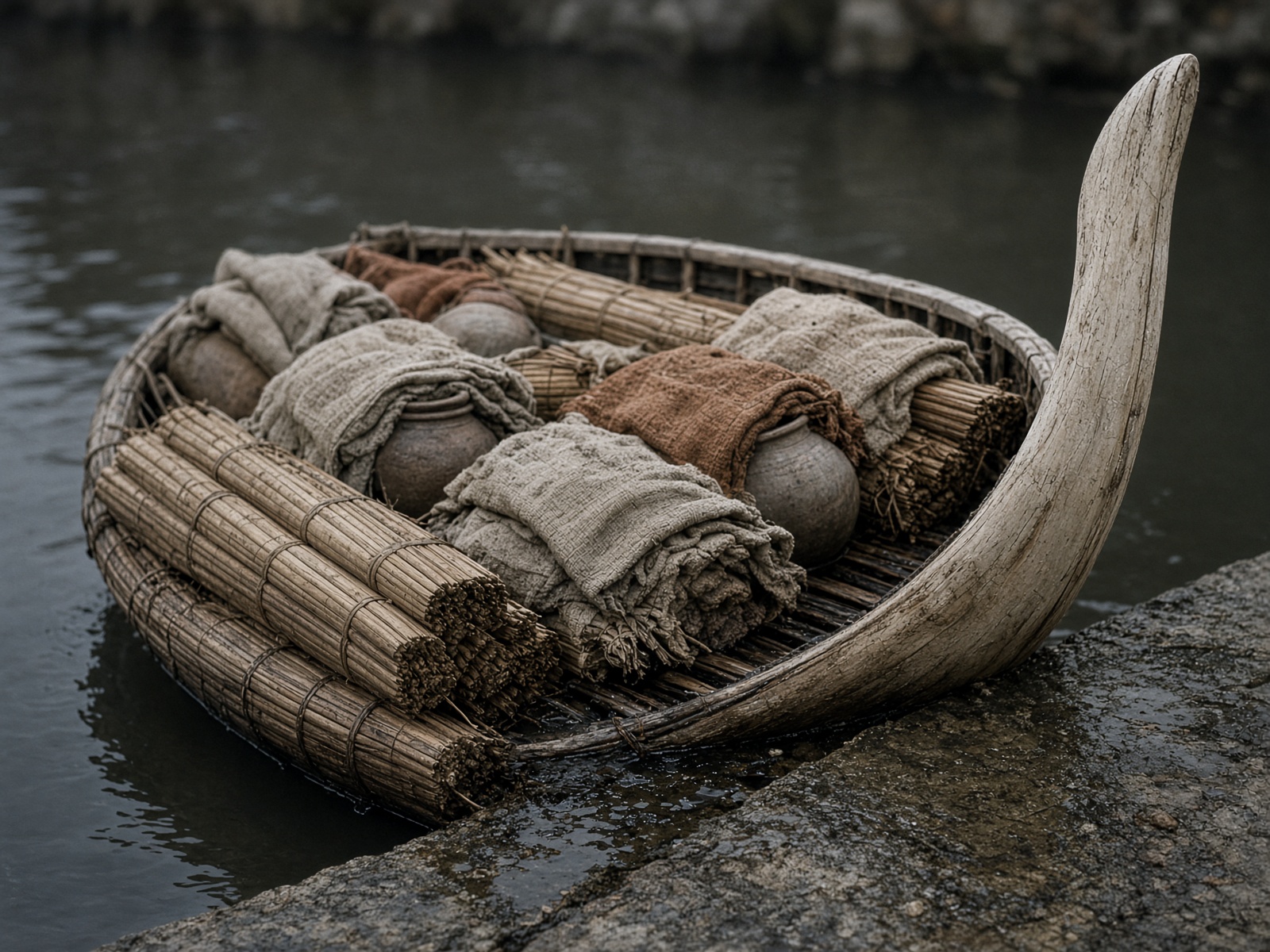
A picture of a reed boat on dark water is atmosphere. It is not the Boat of Heaven, and it is not evidence.
“Inana and Enki” (ETCSL 1.3.1). Electronic Text Corpus of Sumerian Literature, University of Oxford. Composite Sumerian with English translation.
Open the sourceWhat do we actually know?
Limits that must stay visible
The history
What, exactly, is historical here?
Eridu and Uruk are archaeological cities in what is now southern Iraq. The feast, the chase, and the cargo of me are a Sumerian-language literary composition known mainly from Old Babylonian copies. Enki and Inana are gods of a historical religion, not historical persons. Inana is the same goddess Mesopotamia named as the evening and morning star; this composition is not a planetary table.
The text
A Sumerian narrative in which Inana obtains a long inventory of me from Enki in Eridu and carries them to Uruk by boat, against his later attempt to reclaim them.
The history
Eridu and Uruk are real places. Enki and Inana are gods of a historical religion. The composition as we read it is known from later copies, especially Old Babylonian. It is not a documentary of a historical theft.
The history
The goddess and the planet
Inana, Ištar and Ninsianna are names of one goddess whose sky-form is the planet Venus. That identity is ordinary Mesopotamian religion and astronomy. It is not a plot point of this poem. Enki calls her his daughter here. Uruk already exists. Eridu already holds the me. She does not found civilisation. She moves a mixed cargo from a house that had it to a city that could keep it.
The scholarship
The me
Sumerian me (Akkadian parṣu, in some contexts) has been rendered divine powers, ordinances, offices, arts, cultural norms, essences of ordered life. No single English word carries the range. The list includes crafts and kingship and also deceit, prostitution, lamentation and going to the underworld. If the word feels too large, that is the finding.
The scholarship
What this is not
It is not proof that ‘Sumerians invented civilization.’ It is not a manual of progress from primitive to advanced. Neighbouring peoples without this poem had law, memory, craft and song.
The same goddess
Morning and evening are one body.
- Evening
- look west
- Morning
- look east
- the sun she never leaves
MapLook west after sunset. Look east before dawn. One wanderer, later called Venus. This is not a map of Eridu, and not a sky table. The poem still loads a boat.
From this story only
What this story thinks a world needs
Not only fire and grain. A world, in this telling, needs the craft of the reed-worker and the office of the gudu priest. It needs kindness and the plundering of cities. It needs forthright speech and deceitful speech. It needs the kindling of fire and the extinguishing of fire. It needs sexual intercourse, kissing, the holy tavern, the art of song, venerable old age, judging, and going down to the underworld.
The inventory refuses the modern split between tool, institution, vice, art and relation. That refusal is the story’s sharpness. The comparison with our later lists is ours, not theirs.
What counts as a human capacity?
Knock
ENKI
Shown because its Reverse Reduction 24 caused the research question that built this site. Provenance, not ancient evidence.
English Ordinal
39
Reverse Ordinal
69
Full Reduction
21
Reverse Reduction
24
English letters only. Not Sumerian. Enki remains interesting if the 24 vanishes.