
II · Kulaba
Literary narrative · Legendary figure
The messenger’s mouth is tired.
The speech is substantial. Its contents are extensive. He cannot repeat it.
Transcript
The Message What happens when memory can no longer carry the word? The messenger’s mouth is tired. The speech is substantial. Its contents are extensive. He cannot repeat it. A river city. A road that is a person. The alluvium of southern Mesopotamia is a river country: silt, canals, marsh, cities standing on what the water made. Unug, Uruk in later English, sat on the Euphrates system in what is now southern Iraq. Kulaba, also written Kullab, is a district of that city and, in this poem, a name for it. Enmerkar is called lord of Kulaba. The copies we can read are Sumerian-language literature, written in cuneiform. Most come from the early second millennium BCE: Old Babylonian scribal culture, copying and performing an older Sumerian epic. That is not a day-book from the Early Dynastic kings later attached to Enmerkar. He wants gold, silver, lapis from Aratta. The poem puts Aratta beyond seven mountains. Uruk can be walked by archaeology. Aratta cannot be planted with confidence. It is a literary rival: far, mineral, proud. Lapis is a highland stone. A river city does not grow it. The poem is not a trade invoice. The carrier is a messenger. The road is his body. A message has to fit inside a person who can still walk. Distance Uruk is planted. Aratta is not. The dashed line is the poem’s road, not a surveyed track. Aratta is an open mark because the poem names mountains, not a site we can walk. Lapis is a far mineral, not a pin. The speeches get longer Enmerkar, lord of Kulaba, sends to Aratta for what Uruk does not have. Inana, who has a house in both imaginations, favours him. A messenger runs the distance. Each crossing, the speech he must remember is longer than the last. A message has to fit inside a person. Then it does not. The speech is substantial. Its contents are extensive. He cannot repeat it. Enmerkar pats clay and writes the message as if on a tablet. “Formerly, the writing of messages on clay was not established. Now, under that sun and on that day, it was indeed so.” Because the messenger, whose mouth was tired, was not able to repeat it, the lord of Kulaba patted some clay and wrote the message as if on a tablet. The body reaches its storage limit The poem’s wonder is local. A person cannot hold any more speech. The message moves into matter. The clay is not celebrated as progress. It is an expedient. The lord of Aratta will later look at the tablet as at an object that must be examined and learned: a new kind of difficulty, not the end of difficulty. Hold that before any history of writing is laid over it. The earliest proto-cuneiform tablets from Uruk are centuries older than the kings later attached to Enmerkar. This scene is literature about a tired mouth. It is not the archaeological invention of script. Two hinges Do not crush them into one lesson The Spell of Nudimmud Nudimmud is a name of Enki. In one passage, after the world of the poem is already in motion, the messenger is told to chant an incantation: a day without snake or lion or fear; the lands of Šubur, Ḫamazi, Sumer, Akkad and the Martu addressing Enlil in a single language; Enki changing the speech in their mouths so that the speech of mankind is truly one. That is the text. What the text is doing is contested. A second moment The tired mouth and the patted clay are later in the same composition. They are not a caption for the spell, and the spell is not a caption for them. A world can imagine both a wish about many tongues and a body that can no longer carry a speech. These are two different moments in one composition. Neither is a footnote to the other. The scholarship A spell that will not sit still Samuel Noah Kramer and others read the Spell of Nudimmud as an aetiology of linguistic diversity: a golden age of one tongue, then Enki confusing speech, a cousin, in modern comparison, to Babel. The comparison is modern. The poem does not name Babel. Bendt Alster, Herman Vanstiphout, Catherine Mittermayer and others have argued the opposite direction of time: a future unification, a wish that ambitious lords be brought to one speech, perhaps even to Sumerian. The verbal forms that decide past versus future are genuinely difficult. A third caution: even ‘Enki changed the languages’ is not the same sentence as ‘Enki invented language.’ This site will not write the second. The first remains a dispute. Literary clay is not the Uruk tablets The text. A Sumerian epic in which diplomatic speech lengthens until it is put on clay, and in which a Spell of Nudimmud speaks, in disputed grammar, about the speech of mankind becoming one. The history of writing. The earliest proto-cuneiform tablets come from Uruk, late fourth millennium BCE, centuries before the Early Dynastic kings to whom Enmerkar is later attached in the Sumerian King List. The poem is not a witness to that invention. Gong Yushu and others have underlined the chronological irreconcilability. The limit. A literary scene about writing is evidence of how a later literary culture imagined writing’s origin. It is not archaeological proof of the historical invention of writing. Distinguish them or the site fails. What this story thinks a world needs A world, here, needs a word that can travel farther than a tired mouth. It also needs, in the spell, some relation among the many tongues of Šubur, Ḫamazi, Sumer, Akkad and the steppe. Whether that relation is a lost unity or a future hope is not settled. Capacity, in this telling, is not only having speech. It is what happens when speech is no longer enough. What changes when memory leaves the body?
II
Literary narrative · Legendary figure
Sumerian-language epic; Old Babylonian copies
Literary composition; the copies we read are from the early second millennium BCE
The object
A message patted onto clay
The question
What happens when memory can no longer carry the word?
Bring me there
A river city. A road that is a person.
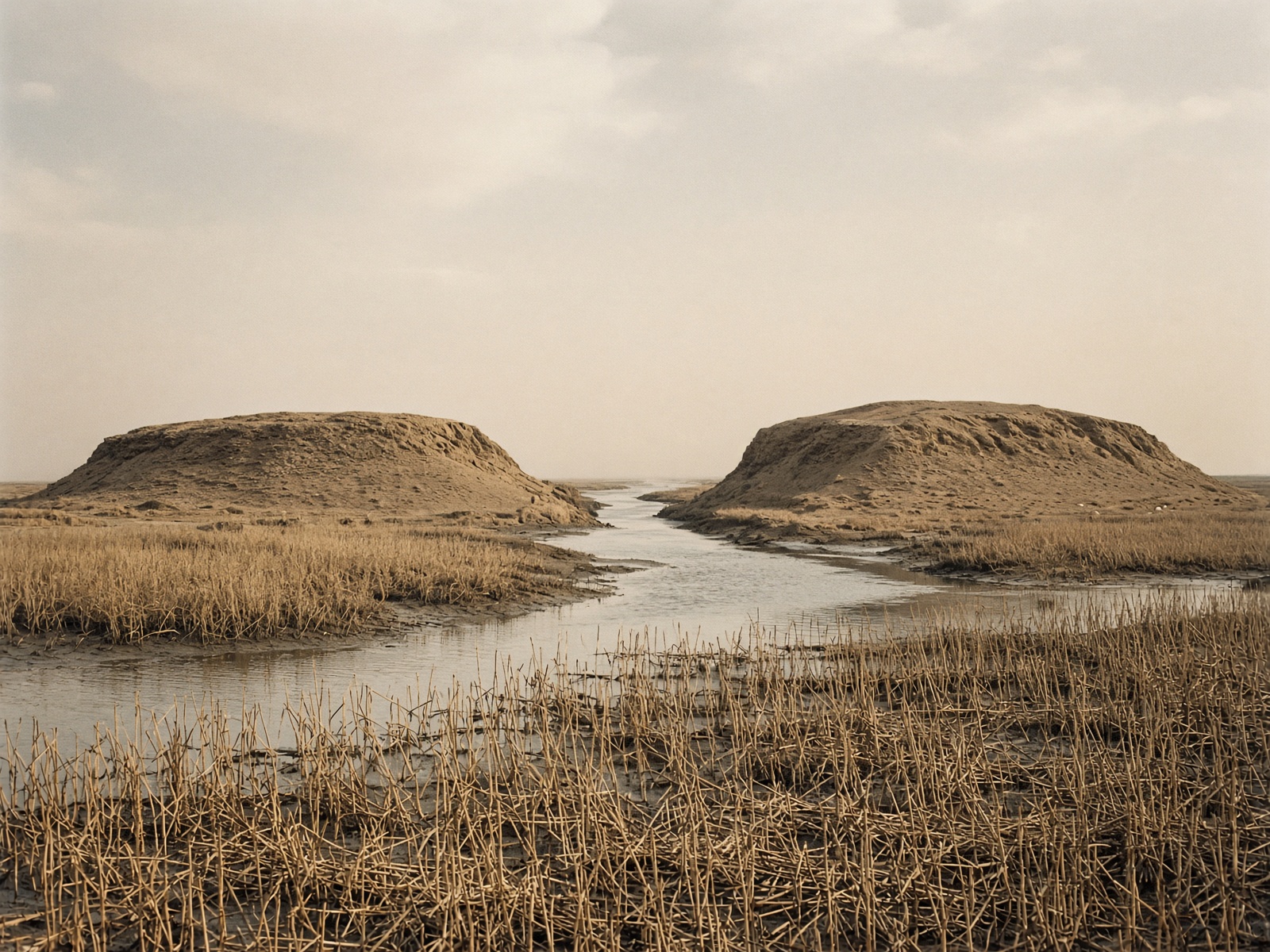
The alluvium of southern Mesopotamia is a river country: silt, canals, marsh, cities standing on what the water made. Unug, Uruk in later English, sat on the Euphrates system in what is now southern Iraq. Kulaba, also written Kullab, is a district of that city and, in this poem, a name for it. Enmerkar is called lord of Kulaba.
The copies we can read are Sumerian-language literature, written in cuneiform. Most come from the early second millennium BCE: Old Babylonian scribal culture, copying and performing an older Sumerian epic. That is not a day-book from the Early Dynastic kings later attached to Enmerkar.
He wants gold, silver, lapis from Aratta. The poem puts Aratta beyond seven mountains. Uruk can be walked by archaeology. Aratta cannot be planted with confidence. It is a literary rival: far, mineral, proud. Lapis is a highland stone. A river city does not grow it. The poem is not a trade invoice.
The carrier is a messenger. The road is his body. A message has to fit inside a person who can still walk.
Distance
Uruk is planted. Aratta is not.
- Unugplanted
- Arattanot a pin
- lapis
- PlantedUruk can be walked
- Named, not plantedThe poem says mountains, not a site
- MineralLapis is a stone, not a city
MapThe dashed line is the poem’s road, not a surveyed track. Aratta is an open mark because the poem names mountains, not a site we can walk. Lapis is a far mineral, not a pin.
Let the story happen
The speeches get longer
Enmerkar, lord of Kulaba, sends to Aratta for what Uruk does not have. Inana, who has a house in both imaginations, favours him. A messenger runs the distance. Each crossing, the speech he must remember is longer than the last.
A message has to fit inside a person. Then it does not. The speech is substantial. Its contents are extensive. He cannot repeat it.
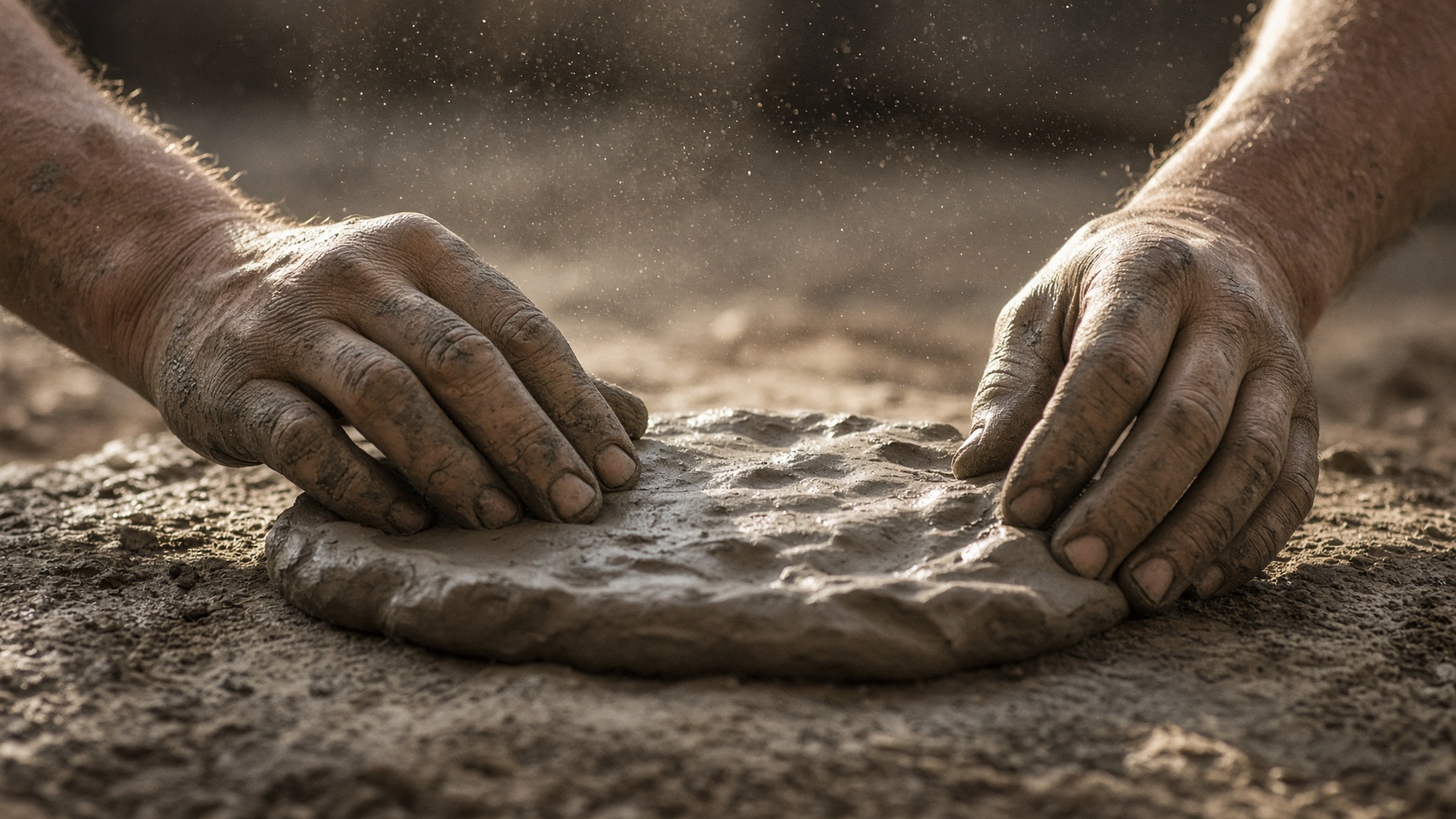
Enmerkar pats clay and writes the message as if on a tablet. “Formerly, the writing of messages on clay was not established. Now, under that sun and on that day, it was indeed so.”

Because the messenger, whose mouth was tired, was not able to repeat it, the lord of Kulaba patted some clay and wrote the message as if on a tablet.
Stop at the strange thing
The body reaches its storage limit
The poem’s wonder is local. A person cannot hold any more speech. The message moves into matter. The clay is not celebrated as progress. It is an expedient. The lord of Aratta will later look at the tablet as at an object that must be examined and learned: a new kind of difficulty, not the end of difficulty.
Hold that before any history of writing is laid over it. The earliest proto-cuneiform tablets from Uruk are centuries older than the kings later attached to Enmerkar. This scene is literature about a tired mouth. It is not the archaeological invention of script.
Two hinges
Do not crush them into one lesson
Language
The Spell of Nudimmud
Nudimmud is a name of Enki. In one passage, after the world of the poem is already in motion, the messenger is told to chant an incantation: a day without snake or lion or fear; the lands of Šubur, Ḫamazi, Sumer, Akkad and the Martu addressing Enlil in a single language; Enki changing the speech in their mouths so that the speech of mankind is truly one.
That is the text. What the text is doing is contested.
Clay
A second moment
The tired mouth and the patted clay are later in the same composition. They are not a caption for the spell, and the spell is not a caption for them.
A world can imagine both a wish about many tongues and a body that can no longer carry a speech.
These are two different moments in one composition. Neither is a footnote to the other.
The scholarship
A spell that will not sit still
Samuel Noah Kramer and others read the Spell of Nudimmud as an aetiology of linguistic diversity: a golden age of one tongue, then Enki confusing speech, a cousin, in modern comparison, to Babel. The comparison is modern. The poem does not name Babel.
Bendt Alster, Herman Vanstiphout, Catherine Mittermayer and others have argued the opposite direction of time: a future unification, a wish that ambitious lords be brought to one speech, perhaps even to Sumerian. The verbal forms that decide past versus future are genuinely difficult.
A third caution: even ‘Enki changed the languages’ is not the same sentence as ‘Enki invented language.’ This site will not write the second. The first remains a dispute.
Show me the source
Enmerkar and the Lord of Aratta
The English sentences quoted here follow ETCSL’s public translation. A newer German edition (Mittermayer 2009) is essential for the language passage. Where they disagree, the disagreement is the scholarship.
ETCSL 1.8.2.3. See also Vanstiphout, Epics of Sumerian Kings: The Matter of Aratta (SBL, 2003); Mittermayer, Enmerkara und der Herr von Arata (2009); CDLI composite Q000369.
Open the sourceWhat do we actually know?
Literary clay is not the Uruk tablets
The history
What, exactly, is historical here?
Uruk is a real city. The earliest writing there is archaeological and centuries older than this poem. Enmerkar is a literary lord, later attached to Uruk in king lists. The tired mouth and the patted clay are a scene in a Sumerian epic, not a dated invention of script. Aratta is a literary rival, not a planted site.
The text
A Sumerian epic in which diplomatic speech lengthens until it is put on clay, and in which a Spell of Nudimmud speaks, in disputed grammar, about the speech of mankind becoming one.
The history
The history of writing
The earliest proto-cuneiform tablets come from Uruk, late fourth millennium BCE, centuries before the Early Dynastic kings to whom Enmerkar is later attached in the Sumerian King List. The poem is not a witness to that invention. Gong Yushu and others have underlined the chronological irreconcilability.
The scholarship
The limit
A literary scene about writing is evidence of how a later literary culture imagined writing’s origin. It is not archaeological proof of the historical invention of writing. Distinguish them or the site fails.
From this story only
What this story thinks a world needs
A world, here, needs a word that can travel farther than a tired mouth. It also needs, in the spell, some relation among the many tongues of Šubur, Ḫamazi, Sumer, Akkad and the steppe. Whether that relation is a lost unity or a future hope is not settled.
Capacity, in this telling, is not only having speech. It is what happens when speech is no longer enough.
What changes when memory leaves the body?