
VII · Pedj-shes
Material evidence · Mythic figure
I take the measuring cord.
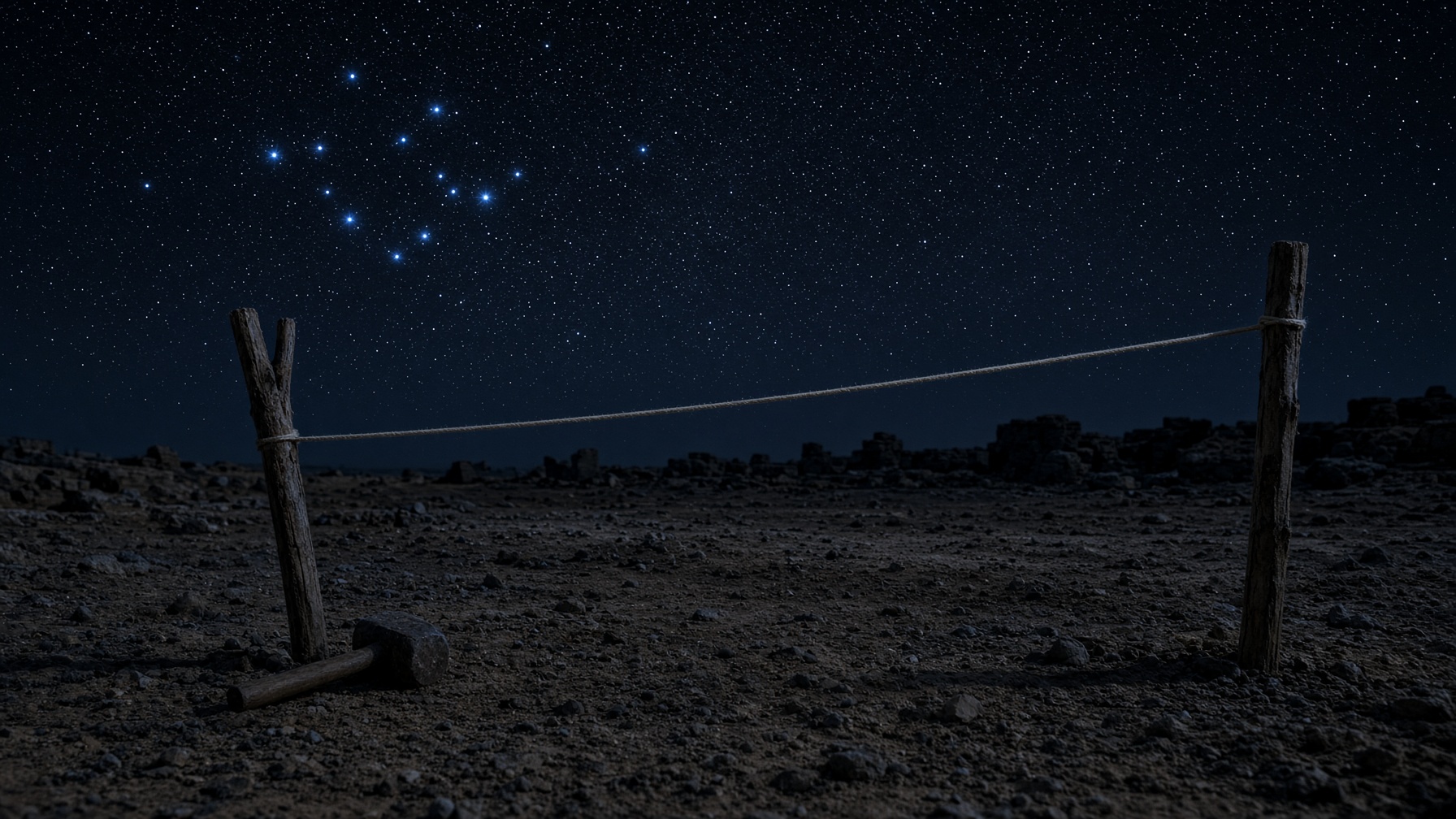
The king and Seshat face each other. Between them a taut line. The house has not been built yet.
Transcript
The Measure Who measures the house a world will live in? I take the measuring cord. The king and Seshat face each other. Between them a taut line. The house has not been built yet. Empty ground, a river, a house that is not yet Egypt is a river country. The Nile makes a narrow living strip through desert. A temple, here, is not a pretty sacred building first. It is a house for a god. Before walls, there is empty ground. The act this room keeps is older than the long speeches. Stakes. A mallet. A mason’s line of flax or fibre. Two figures face each other and pull. The ritual is called pedj-shes: stretching the cord. The four corners of a house that does not yet exist are established on the earth. Seshat is the companion of that act: an Egyptian goddess of writing, record, and measure, attested from at least the First Dynasty. Her name is the feminine of the word for scribe. Later pictures give her a leopard skin, a seven-pointed emblem above a headband, a notched palm rib for the year. Those are attributes. They are not yet the story. The story is the taut line. This is not a theft. It is not a hymn about withheld grain. It is a measurable act attributed to a goddess who is, in the pictures, standing opposite the king with the same tools in her hands. Stakes, a mallet, a line, the stars The oldest picture of the scene is from the Second Dynasty: king Khasekhemwy and Seshat facing each other with poles. The Royal Annals, the stone later called the Palermo Stone, already know a stretching-of-the-cord festival in the First Dynasty. Seshat’s emblem is also on that stone. Those are two different kinds of witness. Do not collapse them into one origin. The longest words we have are much later. At Edfu, a Ptolemaic temple of Horus whose foundations were laid in 237 BCE, the king speaks in the first person. Zaba’s 1953 rendering, as given by Miranda, Belmonte and Molinero, is the English of the pull below. The speech is a royal ‘I’. The Plough is our name for the asterism, not a word in the Egyptian. What the king says he has done: grasped the stake along with the handle of the mallet; taken the measuring cord in the company of Seshat; watched the stars, eye fixed upon Meskhetyu, the Bull’s Foreleg; the god of time-keeping standing by him, in front of his merkhet. Then the four corners of the temple are established. Kurth’s public English of the building chronicle is drier and dated. In year 10 of Ptolemy III, day 7 of Epeiph, at the Senut-festival, the measurements of the temple were laid out on the ground: the extending of the measuring-rope at the foundation. The same rope is named again when the pronaos is founded, a century later. The house keeps a memory of having been measured. Hatshepsut’s Red Chapel at Karnak shows the same facing pair, eighteenth dynasty. That relief does not name the star. The Edfu speech does. Do not read the later sentence back into the earlier picture as if the picture had said it. I have grasped the stake along with the handle of the mallet. I take the measuring cord in the company of Seshat. I observe the progressive movement of the stars. My eye is now fixed upon Meskhetyu. The god of time-keeping stands by me, in front of his merkhet. Then, I have established the four corners of the temple. The house is measured before it exists The object is ordinary. Flax or fibre, two stakes, a mallet. The strangeness is the timing. Measure comes first. The corners are established while the ground is still empty. A world, in this telling, cannot live in a house that has not first been laid out against something larger than the house: the stars, the four directions, a goddess who keeps count. The Pyramid Texts already know Seshat as Lady of Builders. In utterance 364, Nephthys assembles the limbs of the dead king in her name of Seshat, lady of builders. A body can be gathered as a house can be gathered. That comparison is the poem’s, not a modern architectural metaphor laid on top. Writing is a different office. The Message already told a Sumerian literary scene in which a tired mouth is answered with clay. This room will not steal that scene and recast it as Egyptian. Seshat is also a goddess of record. Record is not the same sentence as ‘Seshat invented writing, Thoth taught it to man.’ Those are later tidyings. Keep the cord poorer than the tidyings. Kept apart A ritual is not a later book A measurable act Early pictures, royal annals, and Ptolemaic speeches agree on the tools: stake, mallet, line, four corners. Seshat is the companion of that act. The walk was missing measure. This is the act. A later initiation The Demotic Book of Thoth, edited by Jasnow and Zauzich, is a Ptolemaic and Roman initiation text. It is not the origin of writing. It is not Old Kingdom. It is not this room. It remains held, on purpose. Do not flatten Seshat to Egyptian Hermes. Do not use a later book as a caption for an early ritual. Ritual, later words, a miss The act. A foundation ritual in which the king and Seshat stretch a measuring cord, drive stakes, and establish the four corners of a temple. Early reliefs show the facing pair with poles. Edfu names the stars and the merkhet. The chronology. The festival is named in the First Dynasty annals. The oldest known picture is Second Dynasty (Khasekhemwy). The longest speech is Ptolemaic (Edfu, foundations 237 BCE). Hatshepsut’s Red Chapel shows the scene without naming the asterism. These dates must stay in view together. The scholarship. Zaba 1953 remains the hinge for the Edfu and Dendera speeches. Miranda, Belmonte and Molinero 2008 reconstruct the ceremony and offer a hypothesis that Seshat’s emblem schematises a sighting instrument. That hypothesis is interesting and not settled. Report it as a hypothesis. Temple orientations are not all Meskhetyu; some follow the sun, other stars, or the land. What this is not. It is not proof that Egyptians invented measurement. Neighbouring peoples surveyed. It is not the origin of writing. It is not Hermes. It is not Inana’s lapis-lazuli measuring rod and line, which belong to a descent already housed elsewhere. SESHAT. On the four English faces: 72, 90, 18, 36. Miss. THOTH misses. MEASURE misses. The number did not put the cord in her hands. The reliefs did. No plate. What this story thinks a world needs A world, here, needs a house that has been measured before it is raised. The cord is not a gift of fire or grain. It is the prior act: corners, directions, a count that can be repeated. It also needs someone to keep the count. Seshat records years, loot, the names of kings, the plan of the ground. Measure in this telling is not only length. It is the office of making a world hold still long enough to be built. Who measures the house a world will live in? A different measuring object Inana carries a lapis-lazuli measuring rod and line into the underworld. That descent stays on The Hero’s Journey. This cord is stretched at a foundation, not removed at a gate.
VII
Material evidence · Mythic figure
Egyptian; Nile foundation rite
Ritual attested from the Early Dynastic; longest surviving speech is Ptolemaic
The object
A mason’s line, stretched between stakes
The question
Who measures the house a world will live in?
Bring me there
Empty ground, a river, a house that is not yet
Egypt is a river country. The Nile makes a narrow living strip through desert. A temple, here, is not a pretty sacred building first. It is a house for a god. Before walls, there is empty ground.
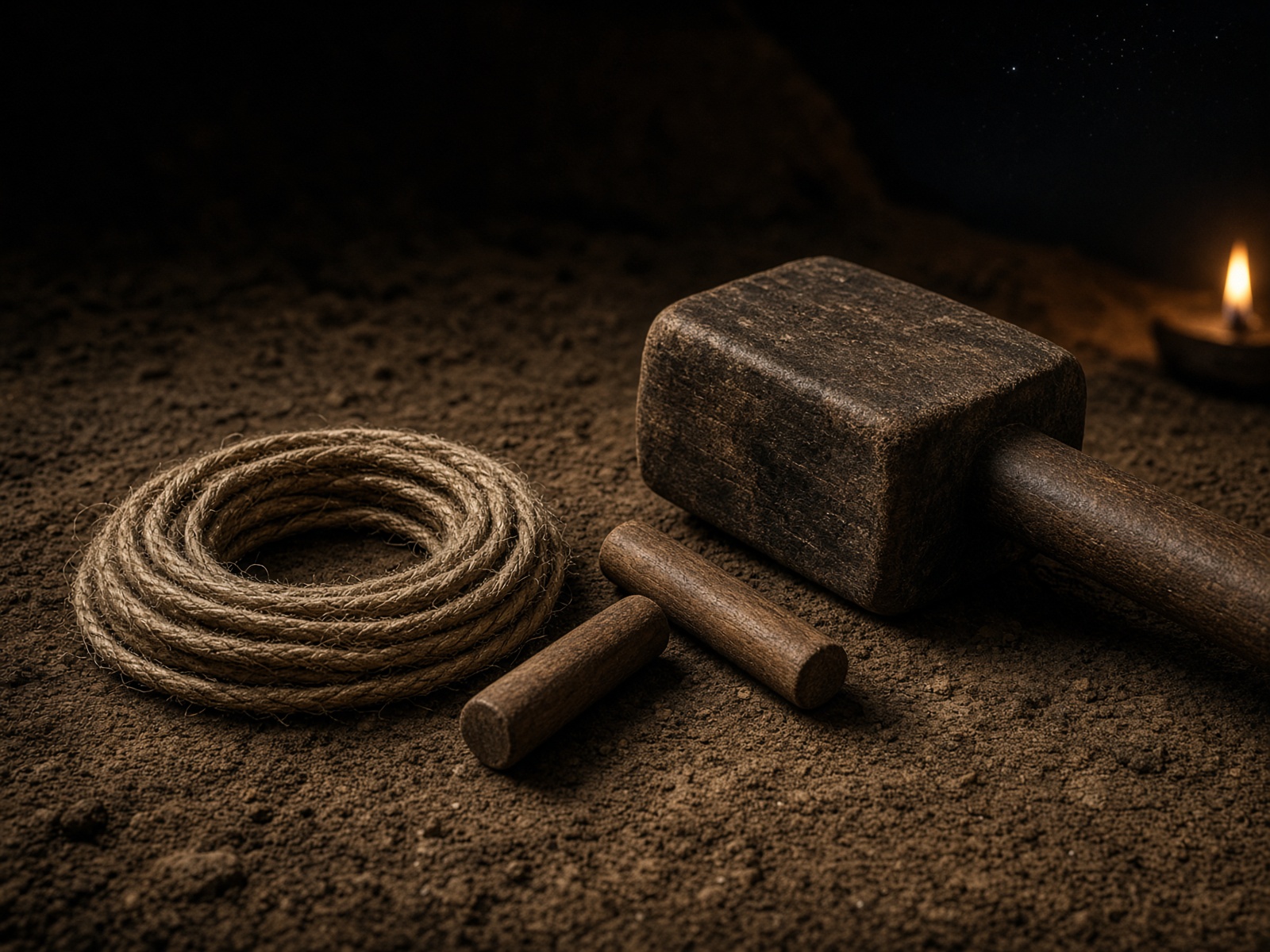
The act this room keeps is older than the long speeches. Stakes. A mallet. A mason’s line of flax or fibre. Two figures face each other and pull. The ritual is called pedj-shes: stretching the cord. The four corners of a house that does not yet exist are established on the earth.
Seshat is the companion of that act: an Egyptian goddess of writing, record, and measure, attested from at least the First Dynasty. Her name is the feminine of the word for scribe. Later pictures give her a leopard skin, a seven-pointed emblem above a headband, a notched palm rib for the year. Those are attributes. They are not yet the story. The story is the taut line.
This is not a theft. It is not a hymn about withheld grain. It is a measurable act attributed to a goddess who is, in the pictures, standing opposite the king with the same tools in her hands.
Let the story happen
Stakes, a mallet, a line, the stars
The oldest picture of the scene is from the Second Dynasty: king Khasekhemwy and Seshat facing each other with poles. The Royal Annals, the stone later called the Palermo Stone, already know a stretching-of-the-cord festival in the First Dynasty. Seshat’s emblem is also on that stone. Those are two different kinds of witness. Do not collapse them into one origin.
The longest words we have are much later. At Edfu, a Ptolemaic temple of Horus whose foundations were laid in 237 BCE, the king speaks in the first person. Zaba’s 1953 rendering, as given by Miranda, Belmonte and Molinero, is the English of the pull below. The speech is a royal ‘I’. The Plough is our name for the asterism, not a word in the Egyptian.
What the king says he has done: grasped the stake along with the handle of the mallet; taken the measuring cord in the company of Seshat; watched the stars, eye fixed upon Meskhetyu, the Bull’s Foreleg; the god of time-keeping standing by him, in front of his merkhet. Then the four corners of the temple are established.
Kurth’s public English of the building chronicle is drier and dated. In year 10 of Ptolemy III, day 7 of Epeiph, at the Senut-festival, the measurements of the temple were laid out on the ground: the extending of the measuring-rope at the foundation. The same rope is named again when the pronaos is founded, a century later. The house keeps a memory of having been measured.
Hatshepsut’s Red Chapel at Karnak shows the same facing pair, eighteenth dynasty. That relief does not name the star. The Edfu speech does. Do not read the later sentence back into the earlier picture as if the picture had said it.
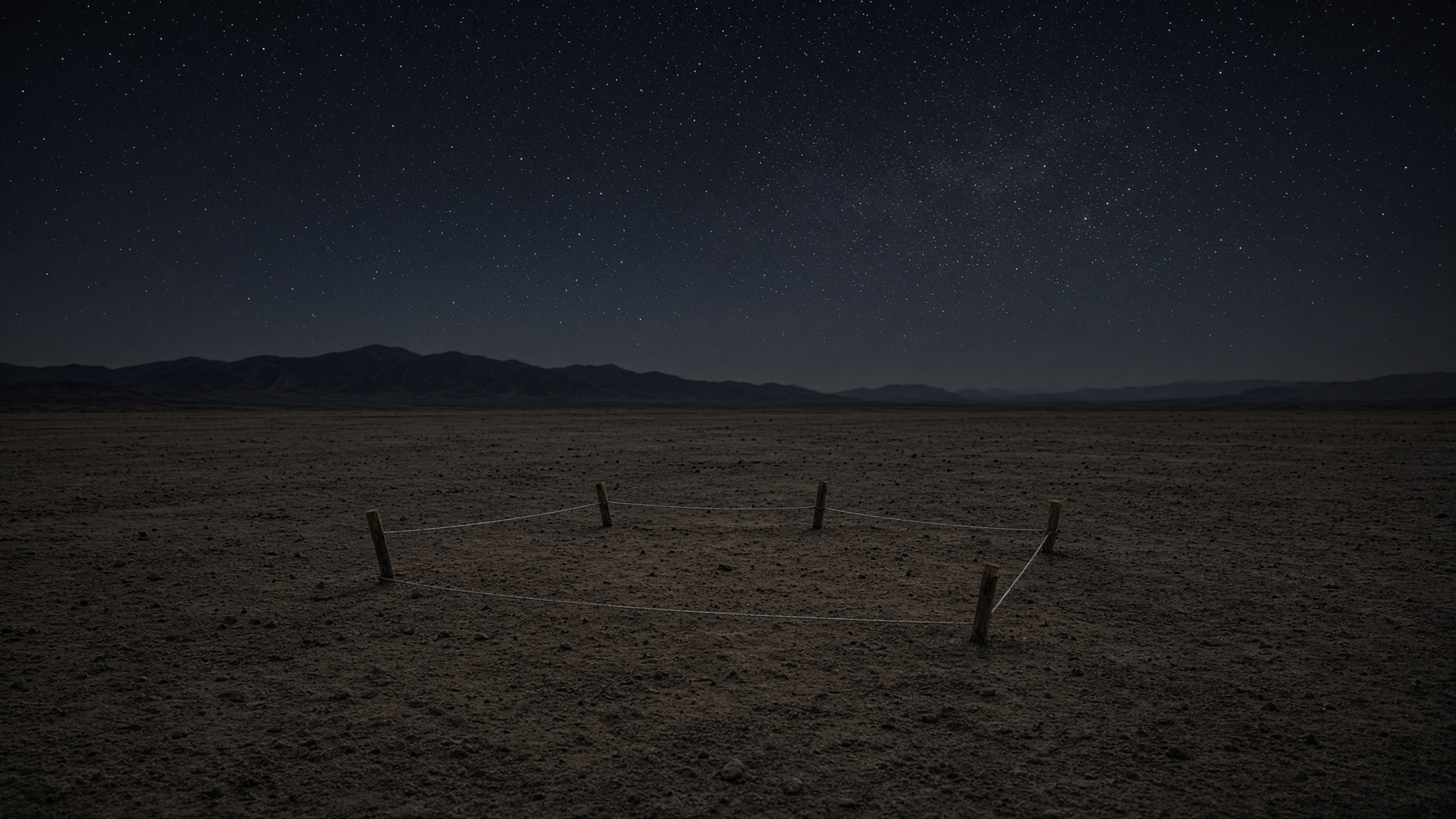
I have grasped the stake along with the handle of the mallet. I take the measuring cord in the company of Seshat. I observe the progressive movement of the stars. My eye is now fixed upon Meskhetyu. The god of time-keeping stands by me, in front of his merkhet. Then, I have established the four corners of the temple.
Stop at the strange thing
The house is measured before it exists
The object is ordinary. Flax or fibre, two stakes, a mallet. The strangeness is the timing. Measure comes first. The corners are established while the ground is still empty. A world, in this telling, cannot live in a house that has not first been laid out against something larger than the house: the stars, the four directions, a goddess who keeps count.
The Pyramid Texts already know Seshat as Lady of Builders. In utterance 364, Nephthys assembles the limbs of the dead king in her name of Seshat, lady of builders. A body can be gathered as a house can be gathered. That comparison is the poem’s, not a modern architectural metaphor laid on top.
Writing is a different office. The Message already told a Sumerian literary scene in which a tired mouth is answered with clay. This room will not steal that scene and recast it as Egyptian. Seshat is also a goddess of record. Record is not the same sentence as ‘Seshat invented writing, Thoth taught it to man.’ Those are later tidyings. Keep the cord poorer than the tidyings.
Kept apart
A ritual is not a later book
The cord
A measurable act
Early pictures, royal annals, and Ptolemaic speeches agree on the tools: stake, mallet, line, four corners. Seshat is the companion of that act. The walk was missing measure. This is the act.
The Book of Thoth
A later initiation
The Demotic Book of Thoth, edited by Jasnow and Zauzich, is a Ptolemaic and Roman initiation text. It is not the origin of writing. It is not Old Kingdom. It is not this room. It remains held, on purpose.
Do not flatten Seshat to Egyptian Hermes. Do not use a later book as a caption for an early ritual.
Show me the source
Annals, reliefs, a Ptolemaic speech
A picture of two stakes and a cord is atmosphere. It is not the Red Chapel, and it is not Edfu. Generated images do not impersonate a relief. The public scholarly door for the ritual speech is the 2008 paper. Kurth’s dated chronicle is a second door. The Palermo Stone is a third. Where they disagree in kind, the disagreement is the scholarship: a festival named in an annal is not the same witness as a goddess drawn on a wall, and neither is the same as a Ptolemaic sentence about Meskhetyu.
Edfu speech: Zaba, L’orientation astronomique dans l’ancienne Égypte (1953); English as given in Miranda, Belmonte and Molinero, Uncovering Seshat, Archaeologia Baltica 10 (2008). Building chronicle: Kurth, via attalus.org. Royal Annals: Wilkinson, Royal Annals of Ancient Egypt (2000). Pyramid Texts 364. UCLA Encyclopedia of Egyptology for orientation. Jasnow and Zauzich 2005 remains the Book of Thoth, kept apart.
Open the sourceWhat do we actually know?
Ritual, later words, a miss
The history
What, exactly, is historical here?
Stretching the cord is a historically attested Egyptian foundation rite. Early reliefs and royal annals witness the act. Seshat is a goddess of a historical religion. The longest surviving speech of the rite is Ptolemaic, centuries after the earliest pictures. The king in those pictures is a historical office.
The text
The act
A foundation ritual in which the king and Seshat stretch a measuring cord, drive stakes, and establish the four corners of a temple. Early reliefs show the facing pair with poles. Edfu names the stars and the merkhet.
The history
The chronology
The festival is named in the First Dynasty annals. The oldest known picture is Second Dynasty (Khasekhemwy). The longest speech is Ptolemaic (Edfu, foundations 237 BCE). Hatshepsut’s Red Chapel shows the scene without naming the asterism. These dates must stay in view together.
The scholarship
Zaba 1953 remains the hinge for the Edfu and Dendera speeches. Miranda, Belmonte and Molinero 2008 reconstruct the ceremony and offer a hypothesis that Seshat’s emblem schematises a sighting instrument. That hypothesis is interesting and not settled. Report it as a hypothesis. Temple orientations are not all Meskhetyu; some follow the sun, other stars, or the land.
The scholarship
What this is not
It is not proof that Egyptians invented measurement. Neighbouring peoples surveyed. It is not the origin of writing. It is not Hermes. It is not Inana’s lapis-lazuli measuring rod and line, which belong to a descent already housed elsewhere.
Miss
SESHAT
On the four English faces: 72, 90, 18, 36. Miss. THOTH misses. MEASURE misses. The number did not put the cord in her hands. The reliefs did. No plate.
From this story only
What this story thinks a world needs
A world, here, needs a house that has been measured before it is raised. The cord is not a gift of fire or grain. It is the prior act: corners, directions, a count that can be repeated.
It also needs someone to keep the count. Seshat records years, loot, the names of kings, the plan of the ground. Measure in this telling is not only length. It is the office of making a world hold still long enough to be built.
Who measures the house a world will live in?